
21 Teves – Reb Yisroel Dov Ber of Vilednik zy”a4 min read
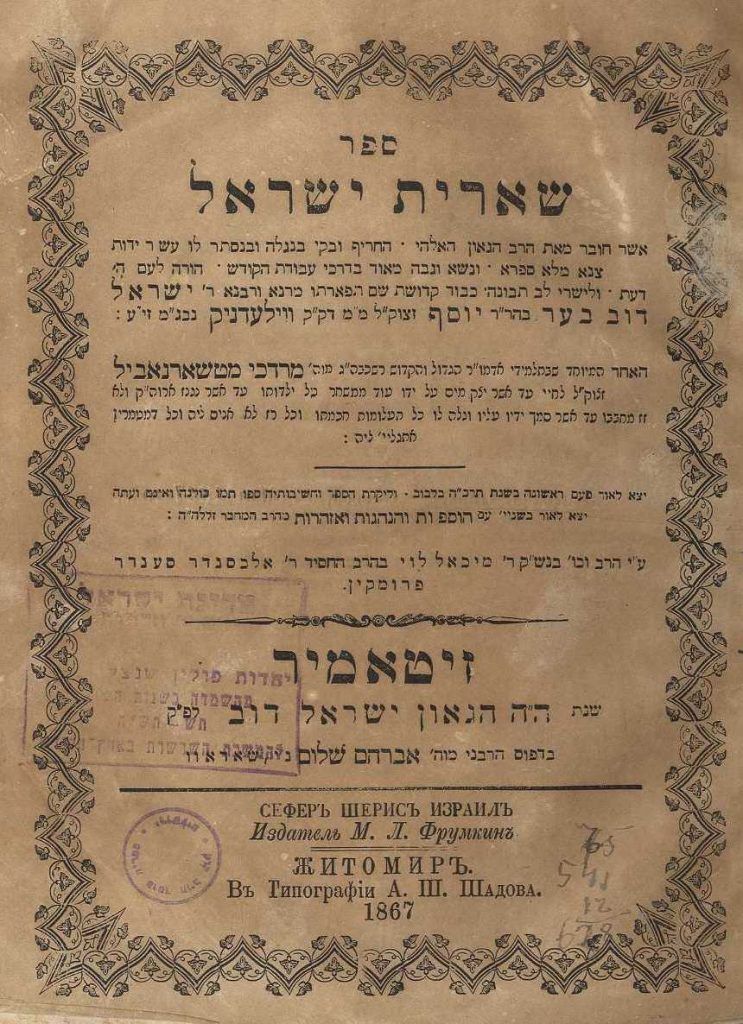
21 Teves is the yahrtzeit of Reb Yisroel Dov Ber (ben Yosef) of Vilednik zy”a, a talmid muvhak of Reb Mottel Chernobyler. He was known for his great Ahavas Yisroel through which he brought many Jewish souls to teshuvah. He was a great miracle worker, and his kever in Vilednik, Ukraine, was always known as a place of yeshuos – even among the non-Jews.
His sefer, She’eiris Yisrael, contain three sections: Shaar Hiskashrus (L’Tzadikim), Shaar HaZemanim and Shaar HaShovavim. Although not an easy sefer, this work, which is composed of teachings compiled by a student, contains many incredible teachings that can be understood on a basic level as well.
Shovavim
Reb Yisroel Dov of Vilednik is famous for expounding at length on the significance of the time-period known as Shovavim – the six weeks from when parshas Shemos is read until parshas Mishpatim.
He passed away on 21 Teves, Shabbos Shemos – the conclusion of the very first week of Shovavim, on a day, Shabbos, which is associated with teshuvah. The 21st day of the month may allude to the divine Name of אקיק, gematriya 21, which Likutei Mohoran 6 teaches represents teshuvah, as it implies a futuristic outlook – “I am prepared to be.” Rebbe Nachman explains there that before one does teshuvah, it is as if he doesn’t exist, since the Gemara teaches that if one sins, “It would have been better if he was not created.” Once one desires to do teshuvah he will now begin to “exist” in the world.
The pasuk in Shemos states אקיק אשר אקיק.
2 times 21 is 42 – the number of days Shovavim contains (in a non-leap year).
The words שובבים ת״ת (a reference to the period of Shovavim during a leap year, which extends to include the weeks of Terumah and Tetzaveh) is equal in gematriya to רבי ישראל דוב ב״ר יוסף ז״ל.
Tikkun HaBris
On the way to Uman from Kiev on 28 Elul, 5767/2007, I was zocheh to be by the kever of Reb Yisroel of Vilednik for the second time. While there, my friend, Rabbi Jay Yaakov Schwartz shlita opened a She’eiris Yisroel to the last piece of Shovavim Likutim, which was on that week’s parsha, Ha’azinu, and we learned the following by the kever.
The tzaddik quotes a teaching of Sefer Raza Meihemna on the pasuk in Ha’azinu, יערף כמטר לקחי תזל כטל אמרתי, which states that תזל contains the first letters of תיקון זרע לבטלה, and the חכמי הדור can rectify this sin even though the Zohar Hakodosh says that, m’D’Oraysa, there is no teshuvah for this.
This is based on the next word in the pasuk, כטל, which may be read as “like 39” – just as the Chachomim were able to limit the number of lashes to 39 even though the Torah says 40, so too, they have the power to rectify this sin.
In several other places, the tzaddik writes that although there is no teshuvah m’D’Oraysa for this blemish, there is indeed teshuvah m’d’Rabanan. Here, we can see the connection between Shovavim and hiskashrus to tzaddikim. (Of course, the concept of tzaddik is bound up with the middah of Yesod, the middah of bris.)
The full verse upon which this teaching is based, יערף כמטר לקחי תזל כטל אמרתי כשעירם עלי דשא וכרביבים עלי עשב has 12 words and 49 letters. There were 12 Shevatim and 49 letters in their names. These Shevatim were the symbol of purity. Sefer Shemos begins by naming all 12 of the Shevatim, whose 49 letters represent the 49 gates of teshuvah available to us. (Likutei Mohoran 36; II, 73)
The date of the Vildeniker’s passing, כ״א טבת תר״י, is equal in gematriya to the words, צדיק יסוד עולם – ברית. Additionally, the word ברית may be seen as the initials of תיקון רבי ישראל בער.
As stated above, the tzaddik is connected with Shabbos, the day he passed away. The words ביום שבת קודש are equal to הרב ישראל דוב בן רב יוסף.
The tzaddik of Vilednik is personally alluded to in the very first pasuk of Shemos: אלה שמות בני ישראל הבאים מצרימה את יעקב איש וביתו באו.
His first name, ישראל, is mentioned in the verse, and the first letters of בני ישראל equal 12, the gematria of his second name, דוב.
Additionally, the words שמות בני ישראל refer to the names of the Shevatim, and דוב is equal to 12 – the number of Shevatim. Both “Yisroel” and the holy Shevatim represent purity in this area of bris.
The words את יעקב איש וביתו באו equal 1327, the gematria of הרב הצדיק ישראל דוב ב״ר יוסף, or, alternatively, הרב ישראל דוב בער בן יוסף זי״ע.
He was the “son of יוסף.” Of course, יוסף is representative of Middas HaYesod – Kedushas Habris.
The last letters of ישראל דוב בער are equal to the word מקבץ, as in מקבץ נדחי עמו ישראל. This berachah is connected to Tikun HaBris and is known to carry special significance during the weeks of Shovavim.
The words נדחי עמו ישראל refer to the fallen sparks caused by this sin that need to be restored. They equal the gematriya of חודש טבת, the month during which Shovavim begins.
His Rebbe’s father, Reb Nochum of Chernobyl, says that the words את יעקב איש וביתו באו teach us that י, which represents “Machshavah Elyonah,” goes down to עקב – a lowly level, into the kelipos, to lift up all the fallen souls (Meor Einayim, Shemos, “V’hinei”). We can suggest that this hints to the Viledniker, who passed away on Shabbos Shemos and lifts up fallen souls, as, spelled out, the letter יוד may be seen as the initials of ישראל דוב וילעדניקער.
At the burning bush, Hashem tells Moshe to remove his shoes because he is standing on sacred ground. As is known, the burial places of tzaddikim are also called “sacred ground.”
Rabbeinu Ephraim writes that the first letters of מדוע לא יבער הסנה spell מילה. It is here that Hashem says אקיק אשר אקיק, mentioned above. The pesukim (4:6-7) state: ויאמר יקוק לו עוד הבא נא ידך בחיקך ויבא ידו בחיקו ויוצאה והנה ידו מצרעת כשלג. ויאמר השב ידך אל חיקך וישב ידו אל חיקו ויוצאה מחיקו והנה שבה כבשרו.
These pesukim can be seen as alluding to performing teshuvah and klopping al cheit – which involves one’s taking his hand in and out. Moshe’s hand became white like tzara’as, which is associated with lashon hora. The Sefrei teach that the Bris of the mouth is connected to the Bris Milah. Additionally, in She’eiris Yisroel (Shoavaim, Drush 1), the Viledniker explains the connection between snow and Shovavim.
The Medrash asks: Where was Reuven returning from when the pasuk states, וישב ראובן אל הבור – “And Reuven returned to the pit,” by Mechiras Yosef? Rebbe Eliezer says this refers to his returning in teshuvah.
Reuven was the first to do teshuvah on his own. This teshuvah was for upsetting the bed of Yaakov Avinu (Bereishis Rabbah 84:19). The Bnei Yisaschar (Kislev Teves, Shovavim) explains that this action was connected to Bris. Therefore, he needed to do an “elevated” teshuva.
Perhaps, we can connect this to the words וישב ידו אל חיקו.
ידו is the first letters of ישראל דוב ווילעדניקער, who taught how to do teshuva in Shovavim. The word וישב can be seen as an expression of teshuvah, and parallels the words וישב ראובן.
Hold On to the Doorknob!
The tzaddik of Vilednik assured: “Even if you do not have access to my kever, if you can touch the door handle, you will be saved.” There were times when the communists sealed access to the kever. However, knowing of the tzaddik’s promise, Jews were able to hold on to the doorknob and receive assistance.
This assurance is needed even today! When I visited the ohel in 2007, the kever was locked – despite our having called ahead of time for the caretaker to open up the Ohel. Remembered this famous directive, we held on to the doorknob and davened. As we were preparing to leave, the caretaker showed up and opened the door.
The initials of the tzaddik’s name, ישראל דוב בער, spells ביד, a possible allusion to holding onto the doorknob.
Zechuso Yagein Aleinu!

R’ Yaakov Klein is the founder of the Lost Princess Initiative, an author, musician, and lecturer devoted to sharing the inner light of Torah through his books, music, and lectures.